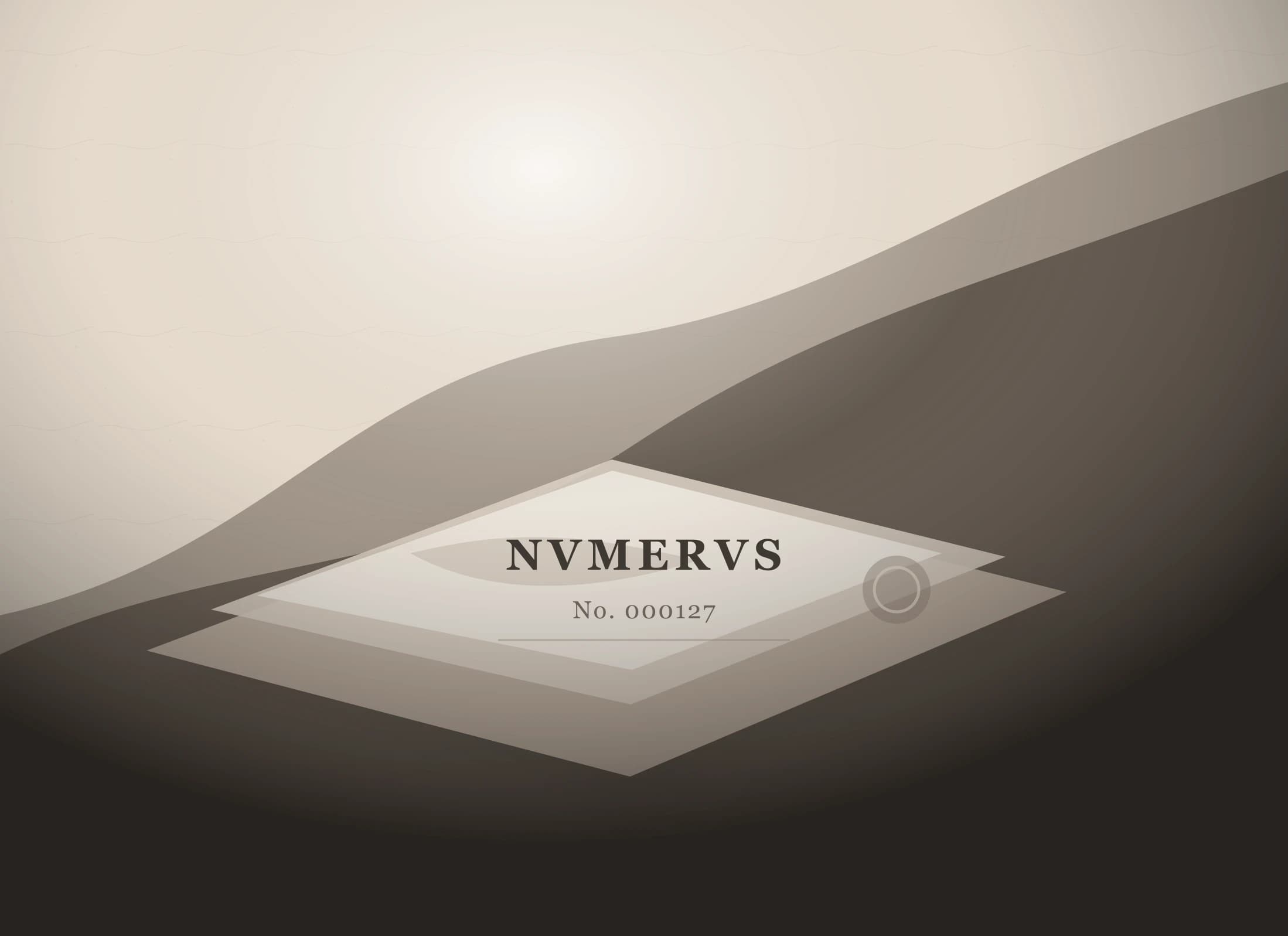
The permanence of memory.
A closed registry of three hundred sixty-five thousand entries. One for every day in a thousand years. Each NVMERVS is recorded in the registry, carved into travertine, printed on cotton paper, and verified on a permanent page at nvmervs.org.
NVMERVS № 000365
Occasion: FONDATIO
One number selected from a closed registry of three hundred sixty-five thousand.
SIGILLATVM
Date: MMXXVI · IX · XIV
The record is written to the registry and bound to its commemorated date.
VERIFICATVM
Proof: OpenTimestamps
The entry appears in the daily root and on its public verification page.
Four forms, one record.
The registry entry is not a digital promise alone. It is a number, a stone, a cotton-paper certificate, and a public verification page. Each form points to the same sealed record.
nvmervs.org registry
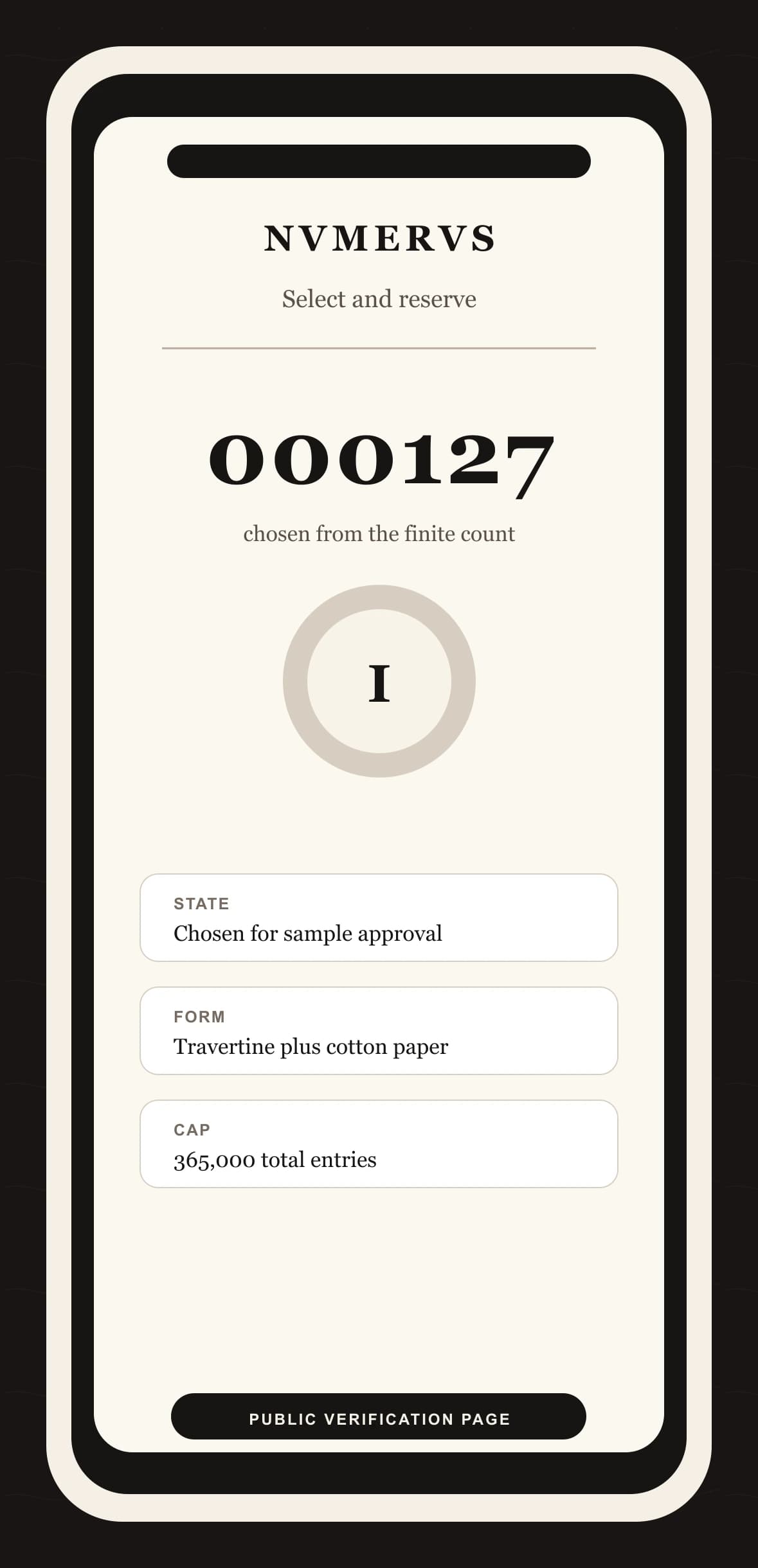
Choose
Search the closed registry and select the number that belongs to the moment.
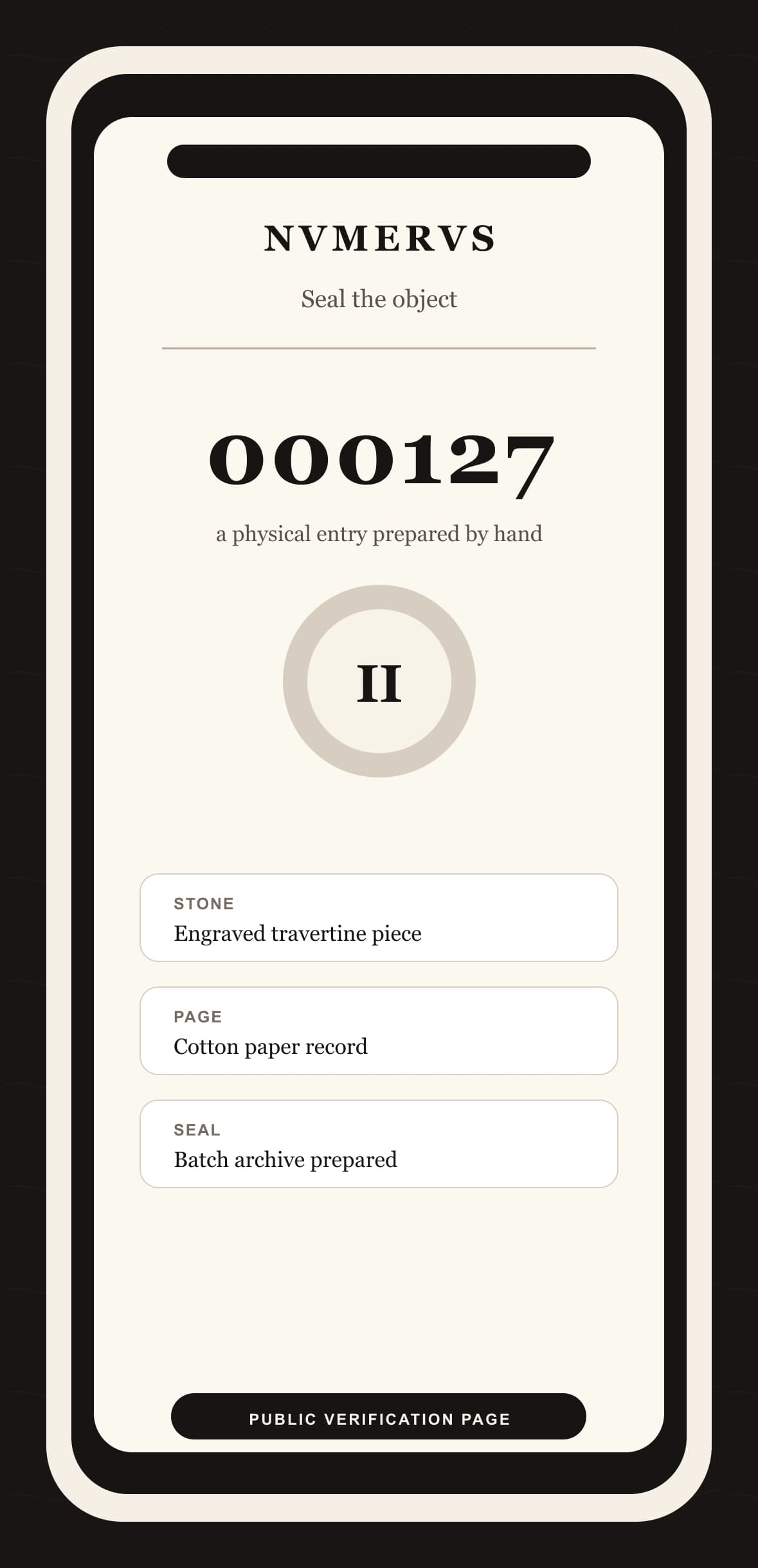
Seal
The entry receives its date, occasion word, certificate text, and registry hash.
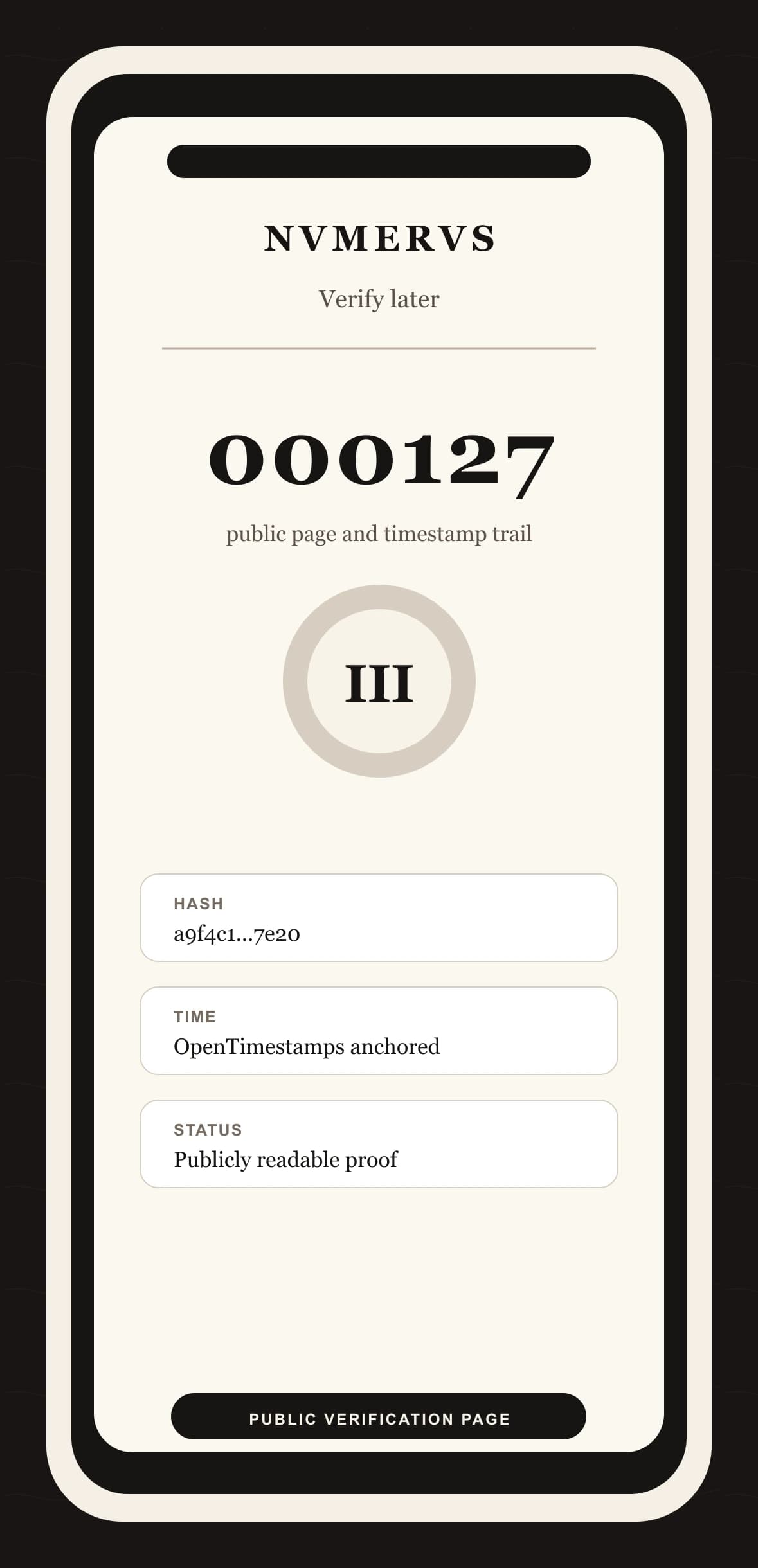
Verify
The public page records the number, date, proof, and letter for future readers.
Choose
Search the closed registry and select the number that belongs to the moment.
Seal
The entry receives its date, occasion word, certificate text, and registry hash.
Verify
The public page records the number, date, proof, and letter for future readers.
What every entry contains.
NVMERVS is intentionally simple. A finite number is chosen. A record is sealed. A stone is carved. A certificate is printed. A public proof is written where future readers can find it.
The cap is the product. When the last entry is sealed, issuance ends.
Each standard stone is intended to ship within fourteen days after sealing.
A portion of each sale is reserved for long-term registry custody and verification.
From moment to record.
The registry is built around a narrow sequence so that the promise remains legible: choose, seal, carve, verify, preserve.
The four witnesses.
The number
One of three hundred sixty-five thousand.
The stone
Travertine carved in the Roman manner.
The certificate
Cotton paper carrying the letter.
The page
The public record and proof.
Proof without spectacle.
The registry is a conventional database, not a token and not a chain. Its public integrity comes from a fixed cap, an open schema constant, daily Merkle roots, and OpenTimestamps proofs that can be checked without a wallet.
A page for future readers.
Every sealed entry receives a public verification page. The page does not perform the memory. It records it plainly: number, date, proof, and the letter the buyer chose to preserve.
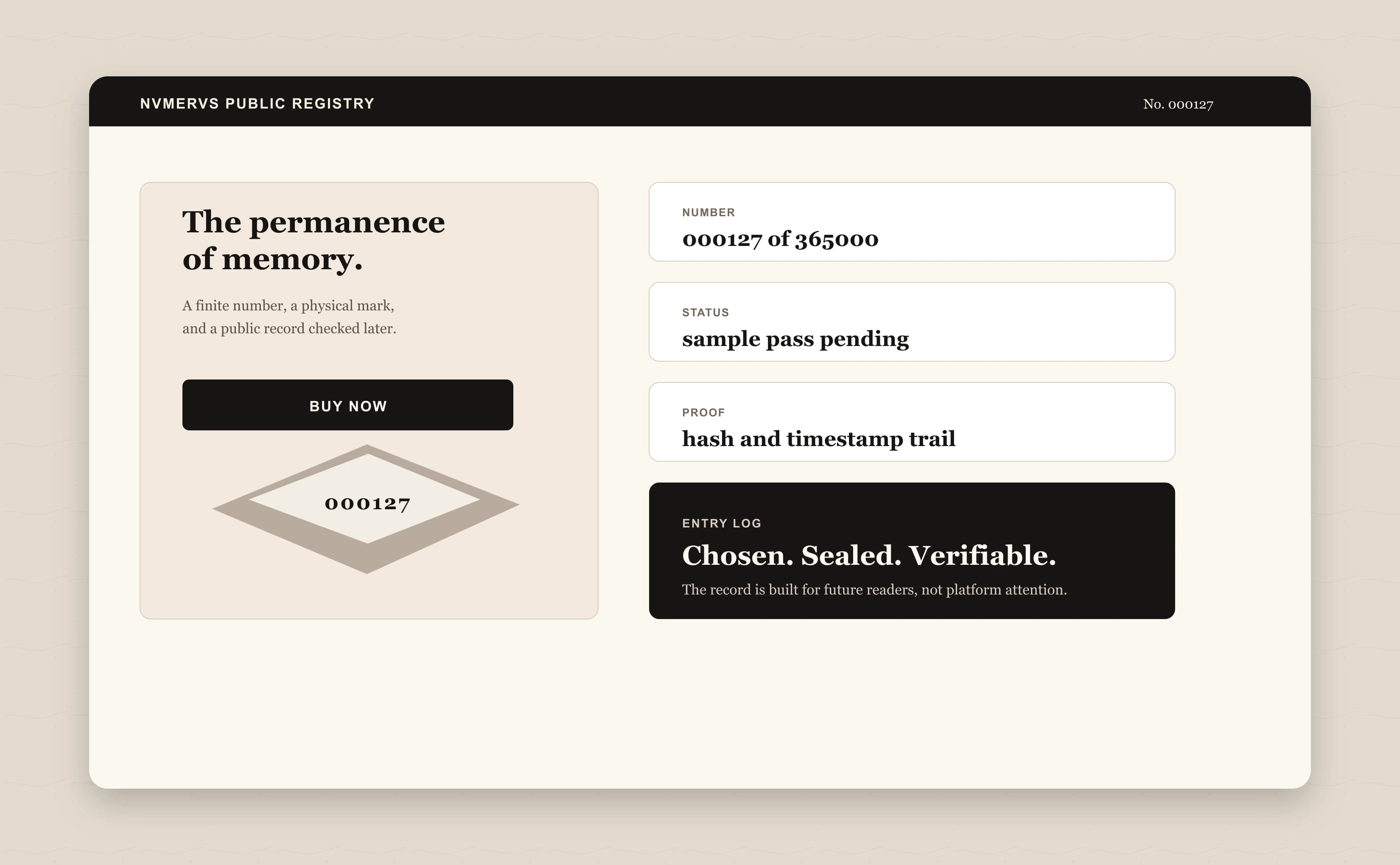
The registry closes because it has a number.
An unlimited registry becomes a feed. A closed registry becomes a record. NVMERVS holds one number for every day in a thousand years, then no more.
The cap is not a marketing limit. It is the structure that lets a number carry weight.
Read the capThe number is chosen
The buyer selects a number from the registry or accepts a standard available slot. The number becomes the center of the record.
The entry is sealed
The registry writes the number, date, occasion word, certificate hash, and proof reference. From this moment the public record exists.
The stone is carved
The travertine tablet is inscribed and packed with the cotton-paper certificate. The digital record and physical artifact now witness the same moment.
Older instruments for a longer record.
NVMERVS is built against the habits of the present internet: infinite feeds, tradable tokens, soft promises, and records that disappear when companies do.
Not a token.
There is no wallet, no chain, no market, no mint. NVMERVS is a conventional registry with a physical artifact and a public proof.
Not an app.
There is no daily habit to maintain and no community to enter. The buyer marks a moment, receives the record, and lets it stand.
Not open-ended.
The registry holds three hundred sixty-five thousand entries. A number matters because another number cannot be added after the cap.
Not only digital.
The page verifies the record. The stone carries it into the room. The certificate gives the buyer's words a paper body.
Custody by proof.
The registry is designed to be exportable, timestamped, mirrored, and legible outside any single server. Custody begins with the operator, but the record is not meant to depend on memory alone.
Not a token.
There is no wallet, no chain, no market, no mint. NVMERVS is a conventional registry with a physical artifact and a public proof.
Not an app.
There is no daily habit to maintain and no community to enter. The buyer marks a moment, receives the record, and lets it stand.
Not open-ended.
The registry holds three hundred sixty-five thousand entries. A number matters because another number cannot be added after the cap.
Not only digital.
The page verifies the record. The stone carries it into the room. The certificate gives the buyer's words a paper body.
Custody by proof.
The registry is designed to be exportable, timestamped, mirrored, and legible outside any single server. Custody begins with the operator, but the record is not meant to depend on memory alone.
The cap must be witnessed.
NVMERVS asks the reader to believe that the registry will close. That belief rests on public documents, open constants, timestamped roots, exportable data, and ordinary infrastructure that future custodians can understand.
The registry holds exactly three hundred sixty-five thousand entries. When the last entry is sealed, no further entries can be added.
One standard entry.
The first public offer is deliberately narrow. One standard NVMERVS entry, one travertine tablet, one certificate, one verification page.
TRAVERTINVM
The standard entry includes the travertine tablet, rigid presentation box, cotton-paper certificate, permanent registry record, public verification page, and the personal letter you write.
- ·One registry number
- ·Travertine tablet
- ·Roman-style inscription
- ·Cotton-paper certificate
- ·Permanent verification page
- ·Personal letter up to 1,500 characters
- ·OpenTimestamps proof after sealing
- ·Workshop shipment target of fourteen days
NVMERI ELECTI
Some numbers carry cultural, mathematical, historical, or personal significance. These may be priced separately or held for later release. The standard terms of the registry remain the same.
- ·Birth years and anniversaries
- ·Palindromes and repeated digits
- ·Mathematical constants and primes
- ·Historic years
- ·Reserved memorial numbers
- ·Screened hate-coded numbers
- ·No resale market
- ·Same cap and same proof
Common questions.
What is NVMERVS?
NVMERVS is a closed registry of three hundred sixty-five thousand permanent entries. One for every day in a thousand years. Each entry marks a single moment and is preserved as a registry record, a travertine tablet, a cotton-paper certificate, and a public verification page.
Why exactly three hundred sixty-five thousand?
Because the number carries its own meaning: one entry for every day in a thousand years. It is large enough for ordinary families to enter, and finite enough for every entry to remain part of a closed record.
What do I receive?
You receive the number, the travertine tablet, the cotton-paper certificate, the permanent verification page, and the personal letter you write. The stone carries the public mark. The certificate and page carry the words that make the moment yours.
Can I choose my number?
Yes. You may search for a number from one to three hundred sixty-five thousand. Some numbers may carry a premium or be reserved. If you do not have a particular number in mind, the registry can assign a standard available number.
Is this a cryptocurrency, NFT, or token?
No. There is no token, no wallet, no mint, and no exchange. NVMERVS uses ordinary legal, physical, and archival instruments: stone, paper, database, public proof, and documented custody.
A number can outlive the moment.
The first entries will be sealed only after the sample stones, packaging, certificate, and public registry proof have passed review. Until then, the record is being prepared with the patience the promise requires.
The button leads to pricing until checkout opens.